It’s not unusual in my dreamworld to see people from my past, people I don’t know, or people who probably don’t exist. The return of my main college Spanish professor wasn’t a shock—after all, he was a major influence in my young adult life—but a couple of months ago, he appeared. And reappeared. I didn’t understand why.
To clear some suspicions, I don’t necessarily believe that the spirits of the deceased visit us during dreams. We have memories of those we’ve lost and it makes sense that our brains recreate these memories while we sleep. However, I also know that no energy ever ceases to exist. The essence of who we are must continue in one form or another.
(Side note: The use of “essence” in my previous sentence is a word used often by the professor who has invaded my dreams lately. Why it popped into my mind just now—well, it happened. He preferred “essence” to “soul”, as “soul” had become a word corrupted by too many religions. That’s a fact I can support.)
After a few nights of these dreams, I began to wonder if he had something to say to me after ten or so years after our last communication, which was by paper mail. I don’t remember anything crucial in that letter and I don’t know where it is. It is safe to say I have nothing tangible of him in my possession.
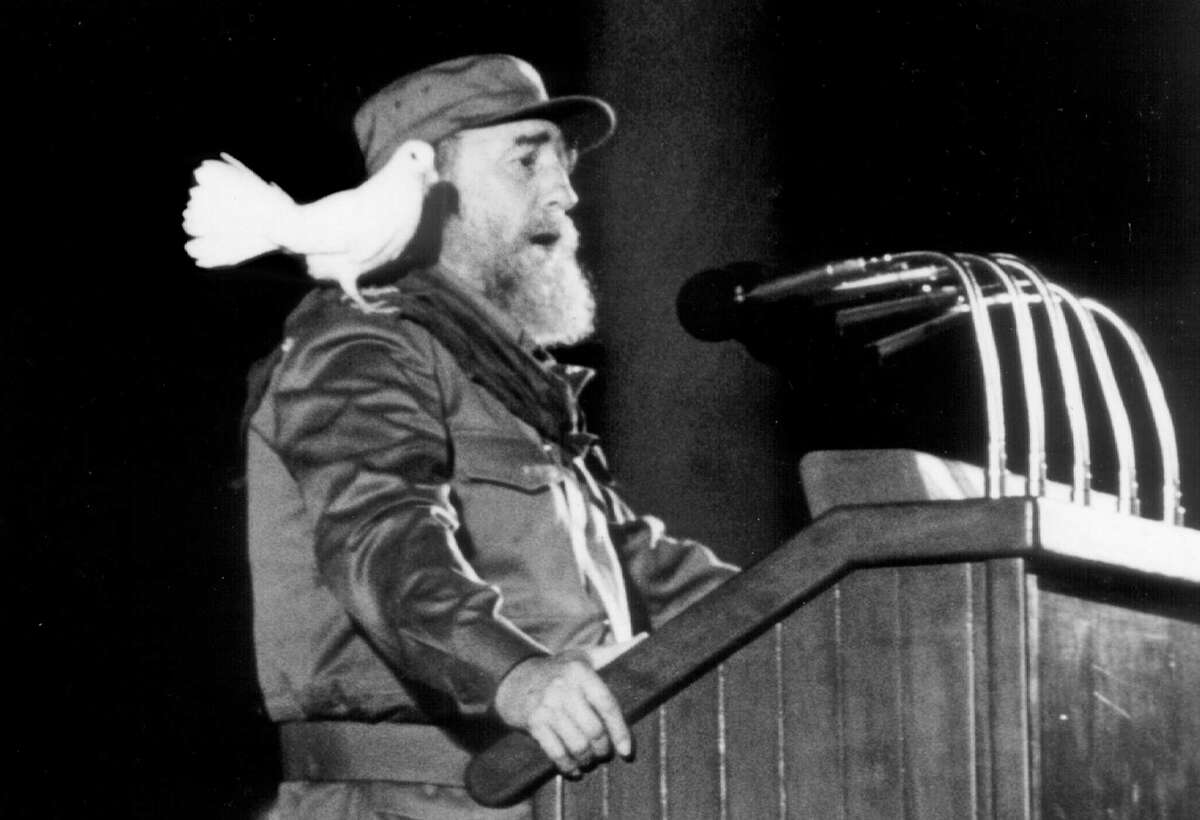
The last night I saw him, his message was clear. He stood with a dove on his shoulder. Remember this conversation.
The iconic moment of Fidel Castro with a dove on his shoulder is burned in my brain as if I had roots in Cuba (which I don’t) because the professor lived a childhood nightmare in Castro’s Cuba. It was only a partial childhood. He had to escape before his teen years, alone, to a country where he knew no one and did not speak English. It was a story I had heard many times in his office, where he had a small wrinkled photo of the famous event in his desk with his Teamster card.
I spent hours of my life in that office with him, especially in my senior year as the president of the university’s language and culture organization. He had many favorite topics. Transubstantiaion in religions more ancient than Christianity. The sustainable weakness of machismo. Seafood and black beans. The genius of Mark Twain (if one dared to venture belong the critics’ favorites). How every story was Don Quixote at its core.
One particular day was darker, though. We had just returned from his Latin-American literature lecture of the week, which had not gone well. He was exasperated with his students, of which I was still one. There had been comments made during his lecture that set him off. I have no memory of what was said or who said it—at that age, I was more aware of the atmospheric change, and how our usually happy (and although I rarely use the word “jolly”, it almost fit him on his best days) had changed.
“What do you see?” he asked me as he gave me the Castro with a dove photo again.
(Side note 2: I remember his voice in Spanish, but I write what he said in English for obvious reasons. However, his English was better than most people born here. He had several degrees, all obtained in English. His mind was truly magnificent.)
“Fidel Castro with a dove on his shoulder, which I know was a staged event, and that you like it that the dove shit on his back is visible in the photos.” We had been through this before.
“It’s a photo to you. And by ‘you’, I mean all of you. All of you born here.”
I knew where his speech was leading. He considered himself American after decades of life with new friends and family since he was first taken in by a priest in Miami so long ago.
“Cuba is my mother, and nothing can replace her. But she is dead. She was murdered not only by this man, but by many who ravaged and dominated her before.”
The history was familiar to me. From his point of view, Cuba’s history was a series of frying pans and fires, all situations favoring some and annihilating others. His family was finally in the “others” category, turning his memories of coconuts on beaches and his grandmother’s kitchen to desolation.
“But we are meant to grow up and leave our mothers,” he continued. “I understand that. There’s just no way to impart what I’ve learned to anyone who hasn’t lived it.”
“That’s not our fault.”
“No, it’s not a matter of blame or fault. But it’s a matter of awareness, and every year I teach, I see less and less of it.”
I didn’t understand it then, although I believed I did. I had yet to accept all the injustices of my own past that were just as ineffable as what he was saying that day. Years later, I would have a similar conversation with a student of my own who was lacking empathy for those who only knew abusive homes, but on this day, I saw a man with a terrifying youth who had survived to make something of himself. Admiration wasn’t what he wanted, though.
“You have such faith in a security that doesn’t exist. You only believe that these atrocities happen somewhere else, to other people. You think you’re above it.”
I tried to interject some levity. “I’ve already apologized for voting for Reagan. I was under the influence of well-meaning but ill-informed people.”
He barely smiled. I knew his opinions of many world leaders, and Reagan was one of the smaller villains in his version of history (or at least he was at the last time we discussed him—at this time of this conversation, there hadn’t been enough distance for a hindsight summary).
Instead he held up the Castro photo again. “People saw this and believed in him. Because of this trained bird, people supported him. Religion supported him. As blood ran down the streets, they believed he would save them. When they starved, they continued to believe him. And he’s not alone. This happens all over the world, every day.”
“You’re saying we’re due for it?”
“No, it’s not ever due anywhere. People let it happen. Good people who are unaware let it happen.”
“You’ll have the satisfaction of ‘I told you so’.”
“I have no satisfaction in it. This is what you don’t understand.” He slid the photo back into his desk. “It can’t be taught. Experience is a bitch, especially when you see history repeating itself.”
At that point, he gave up, because I could not understand. I didn’t. He was right, though. I heard his words, I felt the emotion behind it, and I agreed that not having experienced his life, I couldn’t appreciate it to the profound level he did.
“I’m sorry you had to live in that time period.”
He shook his head. “I am happy to be here. I’m overjoyed to be an American citizen. I believe in this country and what it can evolve to be.”
I waited for the ‘however’, but realized he had started with the rebuttal. My goal that day was only to alleviate the heaviness for the students of his next class. I wasn’t sure I had accomplished it. There was pain in seeing him unhappy, especially when my classmates and I were the cause of it, even unintentionally. Usually, when I was annoyed with him, I tried to remember the day he taught me how to swim under the waves in Acapulco, and the feeling of being lifted back to shore—that sensation of zero gravity that we earthlings rarely feel. As for this day, I felt pushed to the ground.
“Je suis la revolution,” I said, in a last attempt to lighten his mood. He had a bizarre relationship with France, often insulting her as if she were a sibling.
It worked. He responded with a giggle and “Ich bin ein Berliner”, and I knew we were safely onto more musings on the Kennedys.
Over thirty years later, he’s visiting my dreams, borrowing Castro’s glare and with that crapping dove on his shoulder.
Unfortunately, I get it now.
Leave a Reply